23/10/21
Dubliners Reel
6th Biennial of Painting, Zagreb
21/10/21—05/12/21
HDLU, Meštrović Pavilion
Anne Maree Barry, John Byrne, Michelle Doyle, Kevin Gaffney, Léann Herlihy, and Gavin Murphy.
Dubliners Reel
27 October 2021
Seemed as part of 'Dubliners'
6th Biennial of Painting, Zagreb
21/10/21—05/12/21
HDLU, Meštrović Pavilion, Zagreb
Accompanying the Dubliners selection for the HDLU Biennial of Painting, is a specially curated reel giving a glimpse into the layered histories and complex identity of Dublin, through a selection of artists revealing the city through video works. Featuring artists born, bred, educated and active in Dublin City we move through time, language and multiverse with Anne Maree Barry, John Byrne, Michelle Doyle, Kevin Gaffney, Léann Herlihy, and Gavin Murphy.
Curated by Eve Woods, Assistant Curator at Pallas Projects.
Screening notes
Michelle Doyle, Distance from Stone, 2018, Soundtrack - Ivan Pawle and Michelle Doyle [10:00]
Distance From Stone is a visitor centre style video about the history of heritage, stone and the city. Dublin in 2018 is a living museum and one whose obedient citizens have little control over. Taking pebbledash as a symbolic worship of stone and aspiration entirely unique to Ireland, the film negotiates in what way the city has made citizens obedient. Privatization of resources and of history further distance the people who should be able to access them. Is the city an incinerator, which routinely burns heritage and turns it into a combustible gas? This film will answer all that, and send you on your way to the Monument.
Kevin Gaffney, A Numbness in the Mouth, 2016, Irish with English subtitles, 4K Video, [17:32]
A Numbness in the Mouth takes place in an Ireland of the near-future; a self-sustaining, militarized island where climate change has benefited agricultural production. A spokesperson for the government’s Ministry of Food- Gráinne- speaking in the Irish language- informs us that rations are being enforced. Due to a record crop yield of wheat there is a surplus of flour on the market. To retain economic balance between supply and demand, each citizen is requested to consume more than five pounds of flour per day. Following this governmental ruling on consumption, the film moves to Lily (a worker in the mill) sifting flour onto her own head as the mill’s machines swing around her. Later she bathes in a vat of orange jelly, while reflecting on how food affects her temperament.
Shackleton’s Mill in Strawberry Beds, Dublin, provides the context for the film’s two protagonists to explore the role of women in the mill, alongside our relationship to food and its production in a series of staged scenes, monologues and analogies. The River Liffey flows below the mill (previously powering it), with the mill producing flour for nearly 200 years until it ceased operation in 1998. Milling is thought to have operated here since the 12th century. Workers in the mill were mostly men, with women working in the laboratory where the freshly produced flour would be tested and baked.
Shackleton’s Mill was the first place to lock out its workers in 1913. During 1916 it broke the Belfast boycott to acquire their order of white flour sacks. As a result, the mill was held up by the Irish Citizen Army- armed with bombs and guns- and the flour sacks were set on fire in the front yard of the mill. The mill was recommissioned for filming, with grain running through the chutes and rollers. The soundtrack of the film has been built from sounds recorded solely in the mill, and interpolated into the film is a 35mm technicolor infomercial for bread, created in the 1950s, which was found in the mill upon its closure.
The roles in the film are inhabited by Sinéad Ní Uallacháin (a broadcaster with RTÉ Raidió na Gaeltachta) and Jenny Swingler (a performer, writer and theatre director based in London).
John Byrne, Would You Die For Ireland?, 2003, [12:51]
I was commissioned in 2003 to make a work for a Group Exhibition in Kilmainham Gaol entitled Dearcadh. Artists were offered cells in which to respond to the bi-centenary of the death of Robert Emmett who had led the failed Rebellion of 1803. His famous speech from the dock and subsequent execution at the age of 25 made me think about Patriotism and the idea of making the ultimate sacrifice for Nation.
I grew up in west Belfast at a time when the possibility of involvement in something which could have led to incarceration or perhaps even death was real. I think boys and young men are particularly open to this. I’m thankful I was steered in a different direction.
Deciding to make the video was a kind of reflection on that period as much as a response to the ‘brief’.
I used a 3 chip digital video camera which was, in the parlance of the day, ‘broadcast quality’, a decent mic and a tripod. I shot it almost entirely alone over that Summer, usually setting the camera up on the tripod and hitting record when I saw potential participants. Occasionally I held both the camera and mic, as with the Bertie Ahern section. I made the edit roughly in the order it was shot, in Dublin, Cork and Belfast and added John McCormack’s beautiful 1911 recording of ‘I hear you calling me’.
It was projected in the limited confines of a cell and but very popular. It featured on the Marian Finucane show at the time.
Leann Herlihy, target practice, 2021, action to camera [10:10]
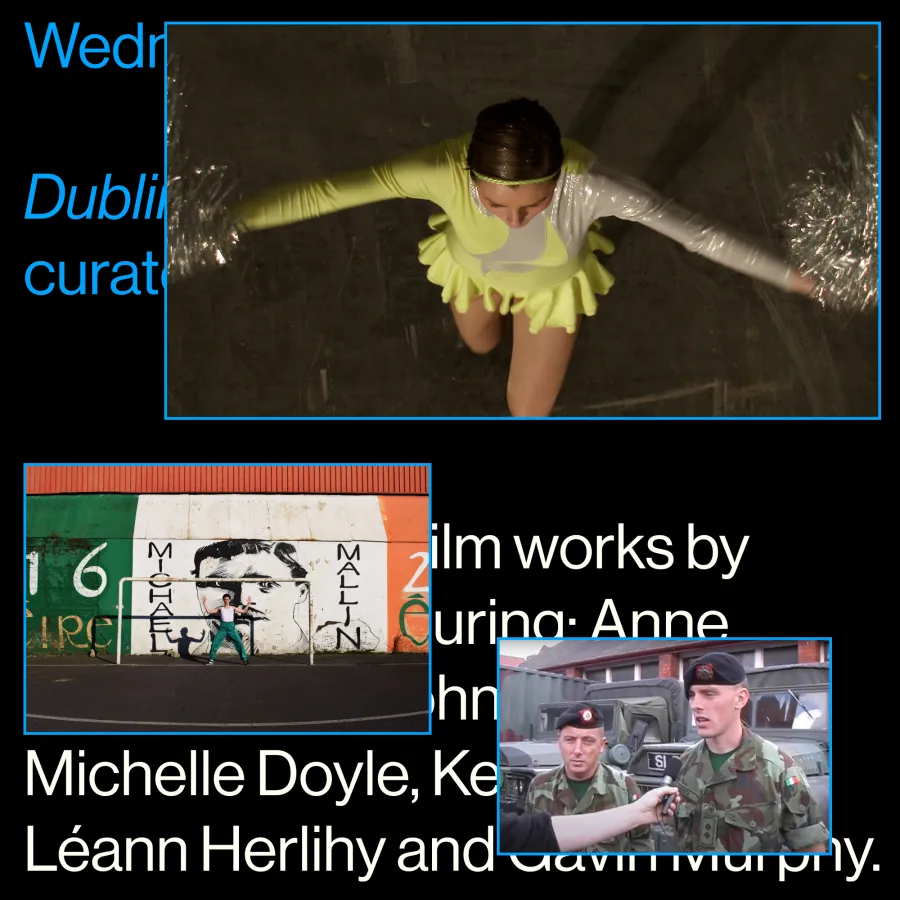
Mimicking the anticipation of a goalie who is awaiting an attack, I shift my bodyweight from side to side as my eyes fixate on you. As time passes, these goalie-like gestures slowly transgress into the broken down actions of a person who is held at gun point; a different kind of target practice. A shift in the soundscape occurs as the low ghostly cheers of football fans becomes evident and further intensifies as my hands raise up to signal surrender. Kitted out in an Irish tracksuit and framed by a bare rusted goal post, my body crouches in front of a centennial wall mural commemorating the Irish Easter Rising. Co-founder of the Socialist Party of Ireland and second-in-command for the Irish Republican Army (IRA)
during the Easter Rising, Michael Mallin joins me in gazing out towards the crowd as the Irish tricolour blazes in the sun. The sound of an early morning Dublin inner city soundscape pierces your ears: birds chirping, cars driving, horses trotting, trains echoing signals.
*
target practice pays tribute to those murdered during Bloody Sunday on 21 November 1920, whereon British Royal Irish Constabulary (RIC) members, or better known as the Black and Tans, entered Croke Park GAA grounds during a football match and opened fire on Irish spectators and players resulting in fourteen fatalities and wounding over 80 civilians. This attack was a response to an IRA operation which took place earlier that morning involving the assassination of the Cairo Gang; a group of undercover British intelligence agents working and living in Dublin. It is said that the RIC believed that the IRA members who committed these morning assassinations were in the crowd at Croke Park, whilst spectators proclaimed that it was an act of terrorism against innocent Irish civilians. In total, 30 people died as a result of this Sunday massacre. target practice was commissioned by Belfast International Festival of Performance Art and was screened both on site at Ulster University and online as part of BIFPA21 online performance programme in March 2021.
Anne Maree Barry, Rialto Twirlers, 2010, [6:17]
In a swirl of pom poms, twirling batons, sparkles and feathers, Rialto Twirlers captures a secret moment of unity and beauty as a dance troupe rehearse their routine for the final time before a national majorette competition. For a year Anne Maree Barry shadowed the Rialto Twirlers. Barry was sufficiently integrated into a precious and hidden Dublin majorette subculture to create this choreographed documentary film, based on her observational experience of the group.
Gavin Murphy, Double Movement, 2017, Film with sound, [45:00]
Production info:
Featuring Eve Woods, Justine Cooper, Craig Connolly
Karl Burke, sound & music
Louis Haugh, still photography
Michael Kelly, cinematography
Des Nealon, voice
Justine Cooper, movement
Oran Day, typography
Peter Mulvaney, wood turning
Colour grade & post-production: John Beattie at Fire Station Artists' Studios
Voice-over recording: Gerry Horan, Contact Studios
Theatre lighting: Margaret-Ellen Donovan
Filming assistants: Greg Purcell and Betsey Goldwasser
Double Movement is a film by Irish artist Gavin Murphy, which stems from the artist's in-depth research into the now defunct Eblana theatre, which was located in the basement of Dublin’s central bus station Busáras. The film seeks to highlight gaps in our collective memory, looking at forgotten cultural movements, and the evidential value of architectural structures, which can reflect and focus a wide variety of social facts. Narrated by the veteran actor and Eblana regular Des Nealon, who voices an intertextual dialogue of shifting points of view (architect Michael Scott, producer Phyllis Ryan, and others) with sources ranging from architectural theory and history, archival extracts, engineering calculations, autobiographical accounts, newspaper reports and theatre reviews.
Busáras was a visionary and contested scheme for 1940s Ireland. At that time, the largest civic building project in post-war Europe, it was lauded and visited by architects from across the continent. Influenced by International Modernism – Le Corbusier in particular – and incorporating the very latest structural techniques courtesy of Anglo-Danish engineer Ove Arup, the building was envisaged as a kind of civic Gesamtkunstwerk (or ‘total art work’), to serve the practical, social and cultural needs of its public users. It's theatre space was taken on by former actress Phyllis Ryan in late 1959 and premièred the early works of Irish playwrights including Brian Friel, Samuel Beckett, and John B. Keane. The Eblana staged plays ranging from populist revues to experimental works, and covered taboo subjects in Ireland of the time such as homosexuality, homelessness and criticism of the Catholic Church. However the artistic fortunes of the Eblana gradually declined, and the theatre was eventually closed in 1995.
Double Movement was funded by The Arts Council and The Arup Trust, and supported by The Irish Architecture Foundation and The Irish Theatre Archive, with thanks to Scott Tallon Walker Architects, Dublin City Archives and Project Arts Centre.
Biographies:
Anne Maree Barry creates site specific film works, text and photography. Her work addresses connections between memory and loss. From subcultures to cities, from working with actors and non actors, her concern is to find a common thread that links the past and the present. Barry's film work has been selected and screened at international film festivals and cultural institutions, such as as the Irish Film Institute, The Dublin International Film Festival, Darklight Film Festival, Aesthetica Short Film Festival, Curtas Vila do Conde, Indie Cork, Les Rencontres Internationales, the LAB, Dublin, Tampere Art Museum, The Glucksman, Cork, The Women's Museum, Aarhus. Her film work Missing Green (2013) is part of F-Rated: Short Films by Irish Women, a varied series of stories told through the prism of the female gaze. The films are drawn from collections preserved in the IFI Irish Film Archive.
John Byrne was born in Belfast, He went to the art college there before attending the Slade School in London (1984-86). Living and working in Dublin since 1996. He’s responsible for a number of high profile public art works including Dublin’s Last Supper (2004), Misneach (2010), a monumental equestrian sculpture in Ballymun. He has a background in performative work including The Border Interpretative Centre (2000) - recently hosted as part of Worlds Without End at Dublin City Gallery The Hugh Lane . He is currently working on a new public artwork for Fingal Co Council. He was elected to Aosdána in 2015.
john-byrne.ie
Michelle Doyle is a multidisciplinary visual artist based in Ireland. Her work critiques technology, politics and innovation through new media. This has seen her work with pirate radio, coding, spatial sound and compositing. Doyle’s work can be found in both institutional and extra-institutional spaces, and is ultimately about questioning the power dynamics found within them.
In her film work, Michelle Doyle defines a new relationship between emerging technologies and the role of film communicating science to society. In particular, she is interested in the use of video in visitor centres and museums. Many of her recent works examine the accelerated nature of engagement technology.
Kevin Gaffney is an artist filmmaker based between Dublin and Belfast. He graduated from the Royal College of Art in 2011 with an MA Photography and Moving Image, and was awarded the first Sky Academy Arts Scholarship for an Irish artist in 2015. He was an UNESCO-Aschberg laureate artist in residence at the National Museum of Modern and Contemporary Art’s Changdong Residency in South Korea (2014) and received the Kooshk Artist Residency Award to create a new film in Iran (2015). A monograph of his work, Unseen By My Open Eyes, was published in 2017. He is currently a PhD researcher at Ulster University.
His work is part of the Irish Museum of Modern Art and the Arts Council of Ireland’s collections and has been shown in exhibitions and film festivals internationally, including: Cork Film Festival (2016 & 2018); European Media Art Festival (Germany, 2016); the 10th Imagine Science Film Festival (New York, 2017); and the Korean Queer Film Festival (2018). Solo exhibitions include: CAI02 Contemporary Art Institute (Japan, 2014 & 2018); Block 336 curated by Kathleen Soriano (London, 2017); Ormston House (as part of EVA’s Public Programme, 2018); and the Crawford Art Gallery (Cork, 2020).
Originally from Waterford, Léann Herlihy holds a MA in Gender Studies from University College Dublin and a BA in Sculpture, Performance and Spatial Awareness from the University of Arts Poznań, Poland. They were the artist-in-residence for Steak House Live Residency Programme, London (2020) and Assembly #2, Simiane-La-Rotonde, France (2019). Solo exhibitions include the middle of nowhere, Project Arts Centre, Dublin (2021); STUNTMAN, ]performance s p a c e[, London (2020); Trojan Horse, STROBOSKOP Art Space, Warsaw (2019). Select group exhibitions and festivals include Slow Sunday, Artsadmin, Toynbee Studios, London [2020]; Foreign Bodies, Zachęta National Gallery of Art, Warsaw (2019); Biennale Warszawa, Mokotowska, Warsaw (2019); ZABIH Performance Festival, Lviv, Ukraine (2019). Léann Herlihy is an artist-in-residence at Temple Bar Gallery + Studios, Dublin (2021-2022). They are the recipient of the Arts Council of Ireland’s Visual Arts Bursary (2021), Agility Award (2021) and Travel and Training Award (2017); Arts Council of Northern Ireland’s Travel Award (2018; 2017) and SIAP General Arts Award (2017); South Dublin County Council’s Young Artist Development Award (2018).
Gavin Murphy is a Dublin-based artist and curator with an interest in cultural sites and histories. His research-based, intertextual practice involves the assemblage of unique fabricated elements, sourced and found objects, images and texts, with an interest in the sculptural possibilities of cinematic structures and mise en scène.
Solo exhibitions include Double Movement, Temple Bar Gallery + Studios, 2017; In Art We Are Poor Citizens, Dublin City Gallery The Hugh Lane, 2014; Something New Under the Sun, Royal Hibernian Academy, 2012; Colophon, Oonagh Young Gallery, 2012; Remember, Dublin City Gallery The Hugh Lane, 2010; and Moving Deaths, The Lab, 2008. Group exhibitions include Tulca 2018: Syntonic State, curated by Linda Shevlin; Selective Memory: Artists in the archive, Lewis Glucksman Gallery, University College Cork, 2015, Changing States: Contemporary Irish Art & Francis Bacon’s Studio, BOZAR, Brussels, 2013, and After the Future, EVA International, Limerick, 2012. He was long-listed for the 2015 Aesthetica Art Prize, exhibiting in York, UK; and his work was included in Les Rencontres Internationales, Paris (2014) & Berlin (2015).
He is the recipient of various awards from the Arts Council and residencies at Fire Station Artists’ Studios, Dublin, and Gertrude Contemporary Art Spaces, Melbourne. He has edited and written for a number of publications including C20 Magazine, the Visual Artists' New Sheet, and AIM (Artists' Initiatives’ Meetings) 2010–2016, Stockholm. His publication On Seeing Only Totally New Things, was published by the RHA in 2013. As co-director/curator of Pallas Projects/Studios, he has devised and realised numerous artist-led projects and programmes. He writes, advocates and conducts research on artist-run practice, and was co-editor of the publication Artist-Run Europe: Practice/Projects/Spaces (Onomatopee, Eindhoven, 2016).
gavinmurphy.info